





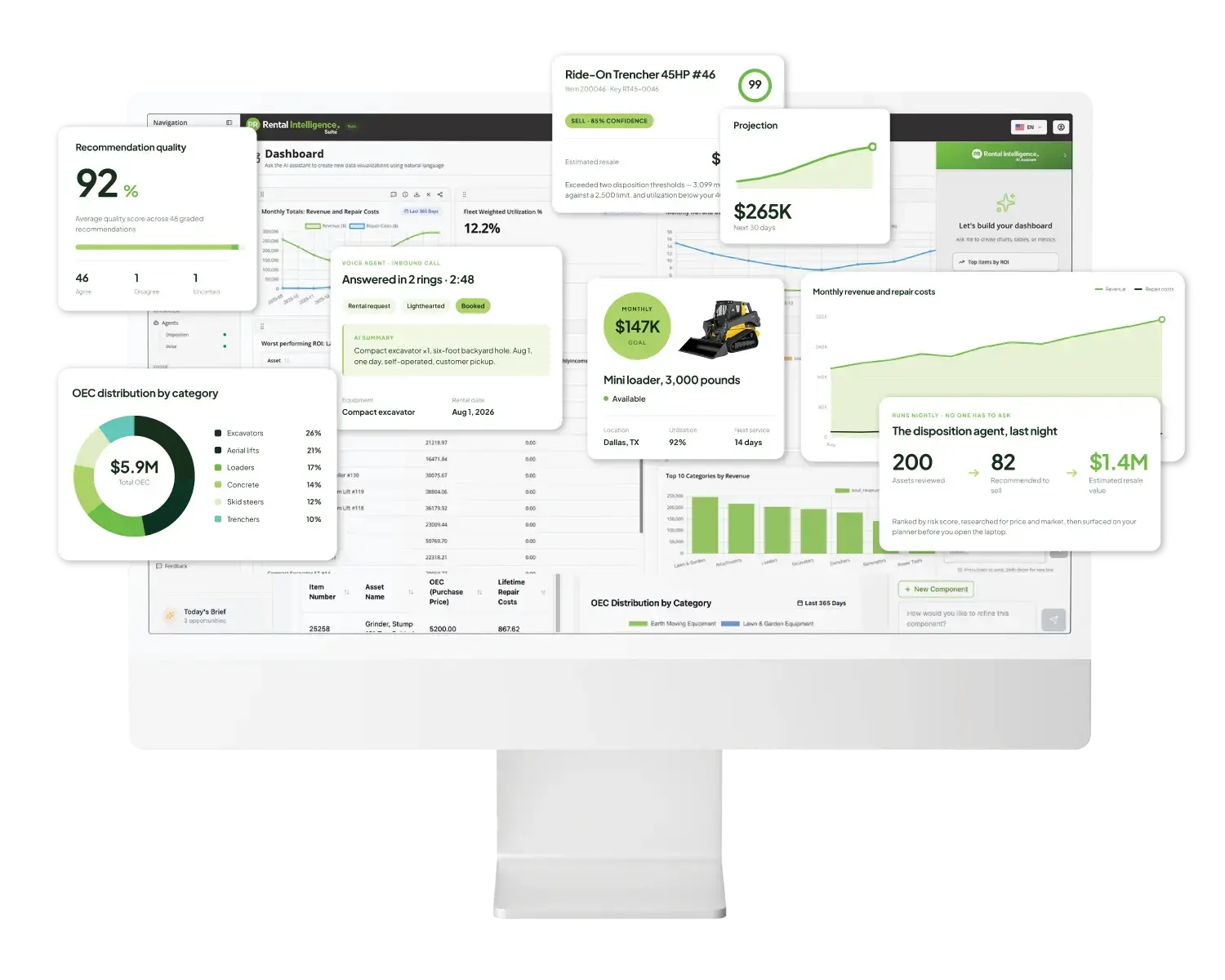
 Turn Data Into Direction

























Table of Contents
- How Rental Businesses Can Turn Data Into a Competitive Advantage
- The Limits of Traditional Reporting
- From Rental Management to Rental Performance
- Making Data Accessible Through Natural Language
- AI-Driven Insights and Observability
- Turning Insights Into Action
- AI in Practice: Voice and Automation
- Lowering the Barrier to AI Adoption
- Getting Started: Practical First Steps
- Turning Insights Into Action With Rental Intelligence Suite
- Key Webinar Takeaways
- Rental Data Today vs. Rental Data as a Competitive Advantage
- Frequently Asked Questions About Rental Data and AI
- Watch the Full Webinar
How Rental Businesses Can Turn Data Into a Competitive Advantage
Rental businesses already have loads of data. The opportunity lies in how that data is used.
In a recent webinar, Point of Rental Vice President of Cloud and Innovation Collin Pike, Head of AI Matt Gaffin, and Product Marketing Manager AJ Lynch explored how rental companies can move beyond static reporting and turn data into a true competitive advantage. The discussion centered on a clear framework for leveraging data across operations.
As Lynch introduced the session, the goal was clear: “Using the data not just to understand your business, but to help drive strategies around your asset base and improve and protect your margins.”
The Limits of Traditional Reporting
Most rental businesses already have reporting tools in place. The issue is how usable that data is in daily operations.
Pike described the gap clearly. “What you’ve been doing for years is putting in tons of data into the system,” he said. “You’ve been able to generate reports…but the clarity and observability just really isn’t there.”
Traditional reports can show what happened. They are less effective at showing what matters right now or what action you should take next.
That lack of clarity creates friction. Teams spend time interpreting reports instead of acting on insights.
From Rental Management to Rental Performance
A key theme throughout the webinar was a shift in mindset.
Pike framed it as moving beyond a system of record toward a system of performance: “We’re really molding into a rental performance system,” he said, with a focus on helping businesses “take action from that data.”
That distinction matters.
A rental management system tracks activity. A performance system helps improve outcomes.
The difference shows up in how data is presented and used. Instead of navigating through reports, users can log in, immediately see what is happening across their operation, and identify where attention is needed.
Pike described the goal as giving users the ability to “go in, log in, observe things that are happening across your different stores, and then take action against them.”
Making Data Accessible Through Natural Language
One of the most practical innovations discussed was natural language interaction with data.
Instead of requiring SQL queries or external reporting tools, users can ask questions in plain English and generate dashboards instantly.
Pike explained that users can “just type in…natural language, like English, and it will generate components into the dashboard system.”
This removes a major barrier to adoption.
Teams no longer need specialized technical knowledge to access insights. Data and data visualization become available to more people across the organization, which increases both usage and impact.
AI-Driven Insights and Observability
Beyond accessibility, the webinar focused heavily on how AI can improve visibility and decision-making.
Pike described the concept of “observability” as the ability to quickly understand what is happening across the business and why.
Instead of manually reviewing reports, the system analyzes data continuously and highlights meaningful patterns.
Some of these insights are powered by what Pike described as AI agents “watching for different scenarios to exist” and evaluating what actions may be needed.
These systems take a broader view of the business, “looking at your store holistically, and figuring out what the best approach is.”
This changes the role of data from passive to active.
Turning Insights Into Action
Data needs action to create value. Throughout the webinar, the focus remained on connecting insights to real business decisions.
Lynch emphasized that the goal is not just visibility, but impact. The system is designed to help businesses “help drive strategy around your asset base” and improve profitability.
One example discussed was asset-level analysis. By evaluating performance at a granular level, businesses can identify underperforming equipment, optimize utilization, and make more informed decisions about their fleet.
Pike also highlighted features such as disposition planning, where the system can flag assets that may need to be rotated out or sold.
This creates a direct link between data and operational decisions.
Areas Where Action Improves Outcomes
- Asset utilization and lifecycle management
- Fleet balancing across locations
- Pricing and revenue optimization
- Maintenance and downtime planning
AI in Practice: Voice and Automation
The webinar also introduced AI applications beyond analytics, including voice-based tools.
Gaffin discussed the role of AI in handling inbound communication, particularly phone calls. Traditional voicemail workflows are inefficient and often ignored.
“Who loves…listening to voicemail messages?” Gaffin said. “You pretty much don’t do that anymore.”
The AI voice agent is designed to replace that friction with a more functional alternative.
“It’s better than voicemail,” Gaffin said. The system can capture customer requests, gather information, and log interactions automatically, creating a more seamless experience for both customers and staff.
Lowering the Barrier to AI Adoption
A consistent concern with AI is complexity and trust.
Gaffin addressed this directly by emphasizing transparency. “Nothing in this application is designed to be a big black box,” Gaffin said. “Everything here is explainable.”
That transparency is critical for adoption.
When teams understand how insights are generated, they are more likely to trust them and act on them.
The system is also designed to improve over time. “We’re also looking at the questions you ask,” Gaffin said, encouraging users to “get creative.”
Getting Started: Practical First Steps
The panel emphasized that adopting a data-driven approach does not require a complete overhaul.
The most effective path is incremental.
Start by improving visibility. Then focus on accessibility. Then connect insights to action.
Pike reinforced that the goal is usability. The system is designed to present information “in a very consumable way” so users can quickly understand what matters and act on it.
Starting Points
- Identify areas where data exists but is underused
- Replace static reports with dynamic dashboards
- Enable natural language access to data
- Focus on decisions that directly impact revenue and utilization
Turning Insights Into Action With Rental Intelligence Suite
The ideas discussed throughout the webinar, visibility, accessibility, and action, depend on having the right tools in place.
Point of Rental’s Rental Intelligence Suite brings those elements together in a way that fits how rental businesses actually operate.
Rather than relying on static reports or disconnected systems, the suite provides a unified approach to understanding and acting on data.
Pike described this shift as giving users the ability to “log in, observe things that are happening across your different stores, and then take action against them.”
That capability shows up in several key ways.
Real-Time Visibility Across the Business
Rental Intelligence Suite provides dashboards that reflect what is happening across locations, departments, and asset groups in real time.
Users can immediately see:
- Performance across stores
- Asset utilization trends
- Revenue patterns and anomalies
- Operational bottlenecks
Key Webinar Takeaways
When data is easy to understand, it gets used. When it highlights what matters, it drives decisions. When it connects directly to operations, it improves performance.
- Make data visible across your entire operation, not isolated in reports
- Ensure data is accessible to all teams, not just technical users
- Use AI to surface patterns and insights automatically
- Connect insights directly to operational decisions
- Focus on improving outcomes, not just tracking activity
- Use tools such as Rental Intelligence Suite to bring visibility, accessibility, and action together in one system
Rental Data Today vs. Rental Data as a Competitive Advantage
| Topic | Traditional Approach | Modern Data Approach | Impact |
|---|---|---|---|
| Reporting | Static, historical reports | Real-time dashboards and natural language queries | Faster decision-making |
| Visibility | Limited observability across operations | Holistic, cross-store visibility | Better operational awareness |
| Analysis | Manual interpretation | AI-driven insights and pattern detection | Deeper understanding of performance |
| Action | Reactive decisions | Proactive recommendations and automation | Improved profitability |
| Accessibility | Technical reporting tools required | Natural language access for all users | Broader adoption across teams |
Frequently Asked Questions About Rental Data and AI
How can rental businesses use data more effectively?
By moving beyond static reports and using real-time dashboards, AI insights, and tools that connect data directly to decisions.
What is observability in rental operations?
Observability is the ability to quickly understand what is happening across your business and why.
Do you need technical expertise to use modern data tools?
No. Natural language interfaces allow users to access data without technical skills.
How does AI improve rental performance?
AI surfaces insights, identifies patterns, and helps prioritize actions.
Where should rental companies start?
Start with visibility and accessibility, then focus on areas that directly impact utilization and revenue.
Watch the Full Webinar
To see the platform in action and hear the full discussion, watch the complete webinar below.