





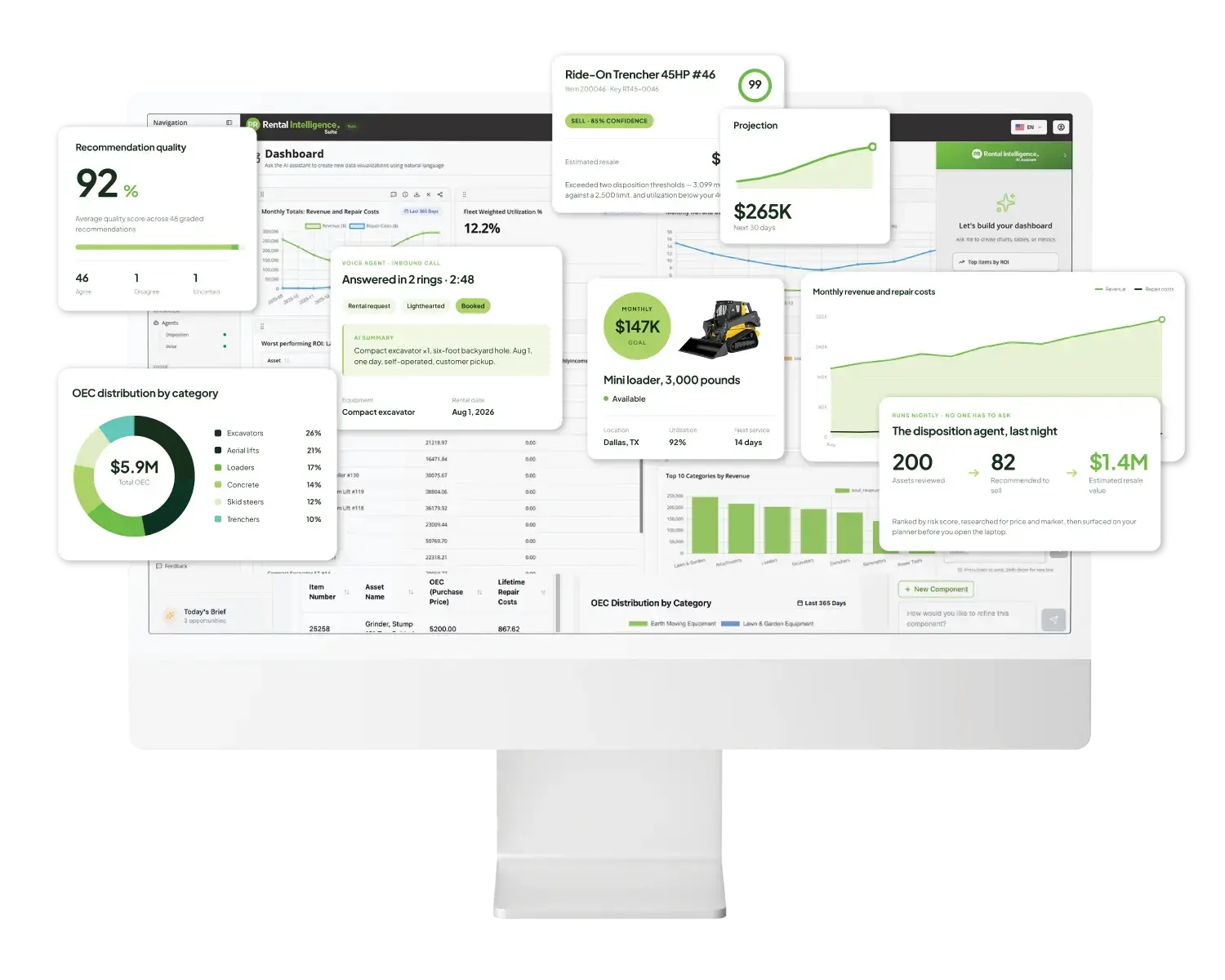
 Turn Data Into Direction

























For years, rental management systems have been seen as digital filing cabinets, mainly used to track contracts, assets, and invoices. That’s useful, but it’s a passive approach. The future of rental software will focus less on recordkeeping and more on awareness.
By 2035, your rental platform will do more than just document the past. It will sense what’s happening in real time, forecast, adjust, and act as needed. I often describe this shift as moving from an RMS as a database to an RMS as a nervous system. The system will see, hear, and respond much as a body reacts to its environment. Thinking about it this way shows just how significant the change will be.
Today, AI is mostly used for automating tasks such as speeding up check-ins, generating descriptions, or drafting emails. That’s helpful, but the next decade will focus on operational intelligence. The software will become an active partner, able to reason, adapt, and learn from the way you work.
That’s the goal we’re working toward.
A Day in an AI-Powered Rental Business: 2035 Scenarios Based on Real Trends
These examples aren’t science fiction. The underlying technologies already exist, such as sensors, telematics, vision AI, conversational interfaces, and adaptive workflows. The difference is that soon, they’ll all work together seamlessly.
Morning Operations That Predict and Prepare Themselves
Imagine walking into your shop early in the morning and finding everything already set up. The system has checked the forecast, noticed the increase in weekend demand, and rerouted deliveries before you even have your coffee. Instead of listing problems, the morning dashboard highlights priorities. Crews see their assigned tasks, deliveries are optimized, and equipment is ready for loading.
The technology to predict and prepare already exists. The key difference will be how closely it integrates into our daily routines. By 2035, rental operations will begin with readiness, not reaction.
Autonomous Logistics and Sense-Driven Inspections
I often use this example when speaking at conferences: A driver unloads a lawnmower and notices a chipped blade. Today, that triggers a cascade of manual steps. In the near future, he’ll simply point and say, “Blade chipped.” Smart glasses capture the image, identify the asset, log the issue, and schedule the repair automatically. The same system will confirm loading sequences, verify weight distribution, and reroute trucks dynamically based on traffic or weather.
This is what I call the beginning of AI’s “five senses”: seeing, hearing, touching, understanding, and acting. The hardware already exists; what we’re engineering now is the intelligence to connect it all.
Instant Visual Quoting and Context-Aware Recommendations
Walk-in customers will soon expect to receive an instant quote from a photo. A bride shows you a picture of her backyard, and within seconds, the system renders a 3D layout, sizes the tent, populates it with inventory, and calculates delivery and staffing automatically. Pricing updates in real time as availability changes. The agent confirms, the customer taps to pay, and the order flows to dispatch.
This is where AI, computer vision, and reasoning models intersect. The next generation of rental software won’t just help you fill orders, it will help you design them.
The Manager’s AI: Insight, Not Alerts
One of the biggest mindset shifts will come from replacing alerts with insights. Traditional alerts tell you something went wrong. Insightful AI tells you why and what to do about it.
Imagine a system that not only detects a spike in maintenance costs for a specific saw model but also shows you that the issue is localized to one construction zone with heavy sand exposure. It offers options: adjust pricing for that region or swap to a more durable model. That’s not an alert; that’s a business recommendation. It changes how managers spend their time and how decisions get made.
The Self-Healing Warehouse
In the self-healing warehouse, equipment doesn’t wait for inspection. It reports its own health. Sensors analyze pump performance as items roll across pads. Cameras detect microfractures invisible to the human eye. The system automatically schedules repairs and removes unsafe inventory from circulation. Every action feeds back into a living maintenance model that improves with every rental.
Of course, trust in automation doesn’t happen overnight. Early on, AI-driven recommendations will appear as suggestions or alerts. But as the system proves accurate 90 to 95 percent of the time, teams will begin accepting those actions automatically. That earned trust is what makes the “self-healing” concept possible.
Finance That Understands Relationships
AI will make financial management dramatically more efficient. The system will automatically handle routine follow-ups and payments, freeing managers to focus on the few exceptions that require personal attention. It will distinguish a new business that’s a few days late from a chronic nonpayer, saving time and reducing manual work.
The result is a workflow that feels less reactive and more intentional, where the system triages routine accounts while humans handle the relationships that truly matter.
Marketplaces, Fleet Sharing, and Autonomous Buyers
The rental ecosystem itself will become connected. Real-time inventory feeds will sync securely with open marketplaces. A construction site’s AI could automatically reserve your attachments. A film crew could book your lighting rigs for a single day. Insurers could adjust premiums based on safety data.
When this happens, you’re no longer a standalone shop. You’re part of an intelligent, self-balancing network of supply and demand. The most successful rental companies will be those who share data and participate in this larger ecosystem.
The Architecture Behind the AI-First Rental Operation
The Unified AI Brain
To get there, we need a platform that thinks as one. A unified AI core with company-wide awareness. It learns from usage patterns, support tickets, metrics, and even the way our own teams build software. It knows contracts, customers, maintenance, and finance equally well. And it doesn’t just react, it reasons.
Bolt-on AI tools will fade because they can’t see the whole picture. The future belongs to unified intelligence that spans every department and every decision.
Microservices and Open APIs as the Real Product
Point of Rental’s evolution toward microservices is about more than flexibility. Each microservice is a living building block, an independent piece of logic that connects seamlessly with others through APIs. They evolve quickly, can be extended by anyone, and are the foundation for continuous innovation.
The Five Senses of the Future Rental Shop
I call this next layer 5SofAI: the five senses of the future shop. Cameras provide vision, sensors provide touch, and audio interfaces enable hearing. Telematics add spatial awareness, and equipment diagnostics reveal vital signs. These are emerging capabilities, gradually transforming the way people interact with technology.
When AI can see what you see, hear what you say, and read what your machines are feeling, typing becomes optional. Interaction becomes natural; it becomes more human.
Transparent Logic: AI That Shows Its Work
No matter how advanced AI becomes, trust will remain its currency. Every suggestion should come with reasoning and confidence scores. Every action should be traceable to its data source. Users should always be able to get a clear answer when they ask, Why did the system decide that?
Transparency isn’t a feature. It’s the prerequisite for adoption.
The Anti-Patterns: What Won’t Survive the Next Decade
Certain software patterns simply won’t make it to 2035. These are the kinds of design pitfalls rental businesses should look for when evaluating their systems:
- Heavy onboarding and training requirements
- Software that doesn’t integrate with other software
- Closed data ecosystems
- AI treated as a bolt-on instead of a foundation
- Reactive, ticket-based support models
The systems that survive will be modular, transparent, adaptive, and continuously improving. They will feel like they were designed for you, because they will learn from you.
How AI Will Reshape Rental Companies by Size
AI maturity won’t be determined by company size but by openness to change. Small shops will benefit first because AI gives them the processes and insights they never had time to build. For larger, multi-branch operations, AI becomes an amplifier of data, turning scale into predictive power.
Every rental business will use the same intelligence layer. What differentiates them will be how they act on it.
How Rental Leaders Can Prepare Today
The most powerful thing rental leaders can do right now is simple: start talking to AI. Upload non-sensitive reports, describe your business, and ask what patterns it finds. Use it to explore ideas, challenge assumptions, and teach yourself how to think with this new tool.
Adoption doesn’t begin with infrastructure. It begins with curiosity. Those who develop the habit of experimentation will be the first to adapt when AI-native systems arrive.
(For step-by-step guidance, see AI for Rental Businesses: Practical Guidance and Tips.)
How Point of Rental Is Building Toward This Future
This vision isn’t theoretical. We’re already building it.
Our AI OCR scanner can identify any asset from a photo. Our AI Supercharger automatically generates SEO-ready product descriptions. AI-powered reporting tools are learning which reports matter most and generating insights automatically.
And our Smart Search engine, coming soon, will let customers describe a job and get recommended tools and inventory instantly.
Each of these features is a stepping stone toward an AI-first platform, one that listens, learns, and acts in real time.
The Rental Businesses That Win Will Be the Ones Who See Further Ahead
The next decade of rental operations will reward foresight, not headcount. The cost of intelligence is dropping, and the expectation for simplicity is rising. The rental businesses that thrive will be those who partner with AI, not those who wait for perfection.
AI will not replace people, but people who use AI will outperform those who don’t. And as our expectations of software rise, as we move from clicking to conversing, from searching to asking, the platforms that adapt will redefine what rental management means.
At Point of Rental, we’re committed to helping our customers make that leap. Because the future of rental isn’t about automation; it’s about amplification. It’s about giving every operator the ability to see further, decide faster, and run smarter.
How Your Rental Business Can Actually Get Value from AI
If you’ve experimented with AI but haven’t quite figured out how it fits into your rental business yet, you’re not alone. This video outlines the three stages most people go through when learning to use AI, and why moving beyond basic questions is where the real payoff begins.